

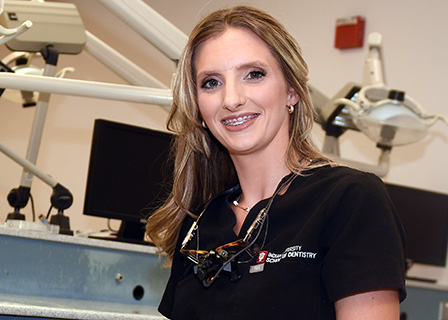
An emerging gap in local anesthesia education sparked an innovative response from third-year dental hygiene student Khris Hahn. Her curiosity, community of mentors, and research-backed solution led to prototype development and could ultimately result in a patent.
Hahn, whose research focuses on local anesthesia and student confidence, observed that realistic practice best prepares students for patient care. Students transition from limited preclinical practice into directly administering injections on real patients.
“That transition can feel abrupt, and for many students, it comes with a significant amount of uncertainty,” Hahn said. “Confidence plays a large role in that moment, not only for the student, but also for the patient sitting in the chair.”
She started thinking more about how to support students before they reach that point—ensuring confidence is high for both new practitioners and patients.
“The work I am exploring is centered around improving that transition,” Hahn shared. “It focuses on creating more meaningful opportunities for students to develop their skills in a controlled, educational environment before working on patients. The goal is not just technical competence, but confidence, because those two things are deeply connected in patient care.”
Supported over time by mentors including Drs. Bruzzaniti, Singh, K. Stewart, Srinivasan, and Thyvalikakath, along with Professors Billing, Cornewell, and Rieck, Hahn's confidence grew as faculty encouraged her development as a dental hygiene student and as a researcher. She indicated their mentorship helped transform gaps in knowledge into opportunities to learn and improve.
With this mindset, Hahn began exploring resources available through IU Innovation & Commercialization, reaching out to determine how her solution could become a reality.
Now, she is working with a group of IUSD faculty mentors to explore product development, including Professor Rettig and Drs. Dutra, Pace, Singh, and K. Stewart. She’s also collaborating with the IU Health 3D Print Lab and Herron School of Art and Design for concepting and prototyping.
Following Hahn's meeting in late June with IU Innovation & Commercialization, the team identified prototype development, grant funding, and pilot testing as the next steps to generate proof-of-concept data before pursuing intellectual property and commercialization opportunities.
“I’m still working with IU Health 3D Print Lab as we now explore materials, sampling, and printing considerations for an initial prototype,” Hahn said. “We have also been fortunate to work with Herron School of Art and Design students, who provided visual renderings that helped us begin bringing the concept to life.”
Without divulging specific project details, next steps include pilot testing and educational impact evaluation.
“If those results are promising, we hope to explore future intellectual property and commercialization opportunities,” Hahn shared.
When commercialization approves intellectual property pursuit, the school will share more specific project details. Until then, best wishes to the project team as development continues and to Hahn, whose positive IUSD experiences led her to apply to public health Ph.D. programs.